Saturday, May 30, 2020

Dark Data


Dark Data: Why What You Don’t Know Matters [Audiobook]

David J. Hand (Author, Narrator), "Dark Data: Why What You Don’t Know Matters"
English | ASIN: B07W99HX3N | 2020 | M4B@128 kbps | ~09:45:00 | 548 MB

A practical guide to making good decisions in a world of missing data

In the era of big data, it is easy to imagine that we have all the information we need to make good decisions. But in fact the data we have are never complete, and may be only the tip of the iceberg. Just as much of the universe is composed of dark matter, invisible to us but nonetheless present, the universe of information is full of dark data that we overlook at our peril. In Dark Data, data expert David Hand takes us on a fascinating and enlightening journey into the world of the data we don't see.

Dark Data explores the many ways in which we can be blind to missing data and how that can lead us to conclusions and actions that are mistaken, dangerous, or even disastrous. Examining a wealth of real-life examples, from the Challenger shuttle explosion to complex financial frauds, Hand gives us a practical taxonomy of the types of dark data that exist and the situations in which they can arise, so that we can learn to recognize and control for them. In doing so, he teaches us not only to be alert to the problems presented by the things we don’t know, but also shows how dark data can be used to our advantage, leading to greater understanding and better decisions.

Today, we all make decisions using data. Dark Data shows us all how to reduce the risk of making bad ones.

Friday, May 22, 2020

Service-Oriented Design with Ruby and Rails


Paul Dix "Service-Oriented Design with Ruby and Rails"
Publisher: Addison-Wesley Professional | English | 2010 | ISBN: 0321659368 | 320 pages | PDF | 3.5 MB
The Complete Guide to Building Highly Scalable, Services-Based Rails Applications Ruby on Rails deployments are growing, and Rails is increasingly being adopted in larger environments. Today, Rails developers and architects need better ways to interface with legacy systems, move into the cloud, and scale to handle higher volumes and greater complexity. In Service-Oriented Design with Ruby and Rails Paul Dix introduces a powerful, services-based design approach geared toward overcoming all these challenges. Using Dix’s techniques, readers can leverage the full benefits of both Ruby and Rails, while overcoming the difficulties of working with larger codebases and teams. Dix demonstrates how to integrate multiple components within an enterprise application stack; create services that can easily grow and connect; and design systems that are easier to maintain and upgrade. Key concepts are explained with detailed Ruby code built using open source libraries such as ActiveRecord, Sinatra, Nokogiri, and Typhoeus. The book concludes with coverage of security, scaling, messaging, and interfacing with third-party services.


Modern Schools of Linguistic Thought: A Crash Course


Add caption
Modern Schools of Linguistic Thought: A Crash Course by Zeki Hamawand
English | PDF,EPUB | 2020 | 132 Pages | ISBN : 3030425762 | 4 MB
“Zeki Hamawand’s textbook offers a reliable and wide-ranging introduction to western linguistics. Its well-structured chapters cover the principal debates and personalities, using an English style that is clear and appropriate for beginners. The book also encompasses the subject’s interdisciplinary relations with other sciences as well as the major methodologies and applications, and whets the reader’s appetite for further explorations of the faculty of language, a distinctive characteristic of humankind.” –J. Lachlan Mackenzie, Emeritus Professor of Functional Linguistics, Vrije Universiteit Amsterdam, Netherlands
"Hamawand is to be applauded for his common-sense and straightforward approach to describing the different schools of thought concerning language and the different areas of investigation within linguistics that one might encounter. He has produced a valuable survey that offers a useful overview of the field to both students and professionals alike. I like this book!" –Brian D. Joseph, The Ohio State University, USA
This textbook provides a clear and concise overview of the main schools of linguistic thought and scholarship from the late 18th century to the present day, examining the key tenets and leading figures of each approach and assessing their impact on the field. Combining theory with practice, the author aims to familiarise students with the mechanisms used in analysing language structures, to acquaint them with the history of the discipline, and to demonstrate how different - sometimes competing - approaches can be combined to understand language and linguistics today. Written in an engaging and accessible manner, this textbook is an ideal primer for new students of linguistics at any level, as well as more experienced researchers seeking to understand the history of their field or the arguments and theories of other sub-disciplines.

The Power of Information Networks: New Directions for Agenda Setting


The Power of Information Networks: New Directions for Agenda Setting (Routledge Studies in Global Information, Politics and Society) by Lei Guo
English | December 17, 2015 | ISBN: 1138847755 | 254 pages | AZW3 | 4.41 MB
The news media have significant influence on the formation of public opinion. Called the agenda-setting role of the media, this influence occurs at three levels. Focusing public attention on a select few issues or other topics at any moment is level one. Emphasizing specific attributes of those issues or topics is level two. The Power of Information Networks: The Third Level of Agenda Setting introduces the newest perspective on this influence. While levels one and two are concerned with the salience of discrete individual elements, the third level offers a more comprehensive and nuanced perspective to explain media effects in this evolving media landscape: the ability of the news media to determine how the public associates the various elements in these media messages to create an integrated picture of public affairs. This is the first book to detail the theoretical foundations, methodological approaches, and international empirical evidence for this new perspective. Cutting-edge communication analytics such as network analysis, Big Data and data visualization techniques are used to examine these third-level effects. Diverse applications of the theory are documented in political communication, public relations, health communication, and social media research.

The Power of Information Networks will interest scholars, students and practitioners concerned with the media and their social and cultural effects.

Handbook of Large-Scale Distributed Computing in Smart Healthcare


Handbook of Large-Scale Distributed Computing in Smart Healthcare


Samee U. Khan, Albert Y. Zomaya, Assad Abbas, "Handbook of Large-Scale Distributed Computing in Smart Healthcare"
English | 2017 | ISBN: 3319582798 | 635 Pages | EPUB | 9 MB
This volume offers readers various perspectives and visions for cutting-edge research in ubiquitous healthcare. The topics emphasize large-scale architectures and high performance solutions for smart healthcare, healthcare monitoring using large-scale computing techniques, Internet of Things (IoT) and big data analytics for healthcare, Fog Computing, mobile health, large-scale medical data mining, advanced machine learning methods for mining multidimensional sensor data, smart homes, and resource allocation methods for the BANs.
The book contains high quality chapters contributed by leading international researchers working in domains, such as e-Health, pervasive and context-aware computing, cloud, grid, cluster, and big-data computing. We are optimistic that the topics included in this book will provide a multidisciplinary research platform to the researchers, practitioners, and students from biomedical engineering, health informatics, computer science, and computer engineering.

Wednesday, May 20, 2020

Flowchart แผนภาพแสดงเส้นทางการไหล/การเดินทางของกิจกรรม


A flowchart is visually an important tool used in visualizing the overview, concept, understanding of a difficult topic and many more others.

Different types of flowcharts are existed and serve different purposes. Some of these flowcharts include the process flowchart, the process map, the functional flowchart, business process mapping, business process modeling and notation (BPMN), and process flow diagrams (PFD) [1]

As per SmartDraw [2], The most common flowchart types are:
  • Process (Business Process) flowchart or Business Process Modeling Diagram
  • Swimlane Flowchart
  • Workflow Diagram
  • Data Flow Diagram


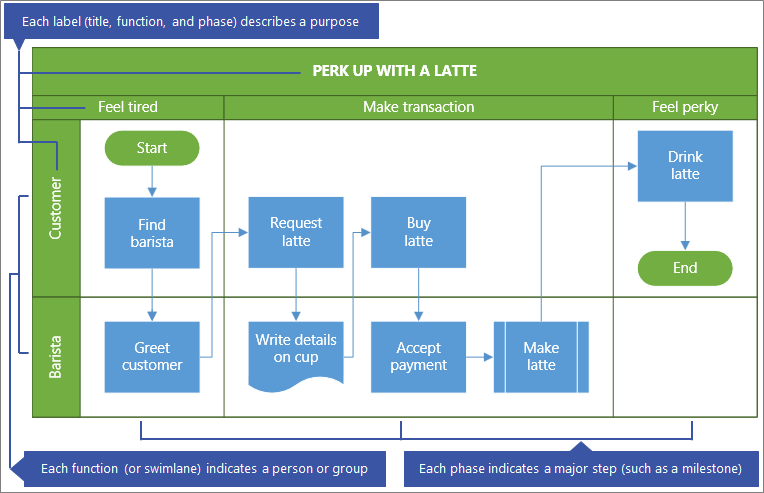
Swim lane/Swimlane Flowchart may sometimes be referred to as Cross-functional flowchart in MS Visio for Web [3] is used to dive deep down more on the otherwise process flowchart and workflow diagram are not designed to serve.

Sample cross-functional flowchart


[1] https://corp.yonyx.com/customer-service/what-is-a-flowchart-and-what-are-the-different-types-of-flowcharts/


[2] https://www.smartdraw.com/flowchart/flowchart-types.htm


[3] https://support.office.com/en-us/article/create-a-cross-functional-flowchart-in-visio-for-the-web-3546da67-a092-431a-b47a-bbb808edf581?omkt=en-US&ui=en-US&rs=en-US&ad=US


Citation and Reference


Cite Them Right: The Essential Referencing Guide, 11th Edition

Cite Them Right: The Essential Referencing Guide by Richard Pears, Graham Shields
2019 | ISBN: 1352005131 | English | 256 pages | EPUB | 3 MB

This is the leading guide to referencing and avoiding plagiarism, covering everything from understanding plagiarism and identifying sources to setting out quotations and creating a reference list. Comprehensive and accessible, it provides readers with detailed examples of print and electronic sources, business, government, technical and legal publications, works of art, images and much more. Packed with practical tips and example sources in both citations and reference lists, it makes referencing manageable and easy to follow for everyone.

The eleventh edition of this bestselling book is an essential resource for anyone doing original research for written assignments, including students, teachers, authors, librarians and non-academic researchers.

Tuesday, May 19, 2020

Scientific Communication


Scientific Scholarly Communication: The Changing Landscape

Scientific Scholarly Communication: The Changing Landscape By Pali U. K. De Silva, Candace K. Vance
English | PDF | 147 Pages | 2017 | ISBN : 3319506269 | 2.24 MB

This book critically examines the historical developments and current trends in the scientific scholarly communication system, issues and challenges in scientific scholarly publishing and scientific data sharing, implications and debates associated with the influence of intellectual property rights on scientific information sharing, and new trends related to peer reviewing and measuring the impact of scientific publications.
Based on thorough examination of published literature, the book illustrates the involvement of many stakeholders—scientists, science educators, university administrators, government entities, research funders, and other interested parties—in this complex and dynamic system. The discussion highlights the roles these stakeholders have to play, individually and collaboratively, to help transform the future of the scientific scholarly communication system.

Bits and Bugs: A Scientific and Historical Review of Software Failures in Computational Science


Bits and Bugs: A Scientific and Historical Review of Software Failures in Computational Science

Thomas Huckle, "Bits and Bugs: A Scientific and Historical Review of Software Failures in Computational Science"
English | ISBN: 1611975557 | 2019 | 251 pages | PDF | 11 MB

Bits and Bugs A Scientific and Historical Review of Software Failures in Computational Science Software, Environments, and Tools 29 In scientific computing (also known as computational science), advanced computing capabilities are used to solve complex problems. This self-contained book describes and analyzes reported software failures related to the major topics within scientific computing: mathematical modeling of phenomena; numerical analysis (number representation, rounding, conditioning); mathematical aspects and complexity of algorithms, systems, or software; concurrent computing (parallelization, scheduling, synchronization); and numerical data (such as input of data and design of control logic). Readers will find lists of related, interesting bugs, MATLAB examples, and excursions that provide necessary background, as well as an in-depth analysis of various aspects of the selected bugs. Illustrative examples of numerical principles such as machine numbers, rounding errors, condition numbers, and complexity are also included. This book is intended for students, teachers, and researchers in scientific computing, computer science, and applied mathematics. It is also an entertaining and motivating introduction for those with a minimum background in mathematics or computer science. Bits and Bugs can be used for courses in numerical analysis, numerical methods in linear algebra/ODEs/PDEs, introductory software engineering, introductory scientific computing, and parallel programming.

Reference Textbooks and Books on Academic and Technical Writing for undergraduate studies in science, tech and engineering.


Creating Research and Scientific Documents Using Microsoft Word Front Cover
Add caption


  • Creating Research and Scientific Documents Using Microsoft Word
  • Author: , 
  • Length: 288 pages
  • Edition: 1
  • Language: English
  • Publisher: 
  • Publication Date: 2013-11-01
  • ISBN-10: 0735670447
  • ISBN-13: 9780735670440

Research fuels innovation—and with this focused guide to Microsoft Word, you can help increase your team’s collaborative power and effectiveness, and bring new research to life. Writing proposals, reports, journal articles, theses, and other technical documents as a team poses unique challenges, not the least of which is consistent presentation and voice. You must also manage the formatting and accuracy of figures, equations, and citations, and comply with the style rules of external publications. In this book you’ll learn from the authors’ extensive experience managing the authoring and publication of technical content, and gain specific practices and templates you can apply right away.

  • Focuses on the unique challenges of writing and producing documents in an academic or commercial R&D setting
  • Demonstrates how to use Microsoft Word to increase the quality of collaborative document preparation—including formatting, editing, citations management, commenting, and version control
  • Includes downloadable templates that help automate creation of scientific documents
  • Offers best-practices guidance for writing in teams and writing in the scientific genre

Table of Contents

Chapter 1: Using templates in Word 2013
Chapter 2: How to design templates
Chapter 3: How to work with headings
Chapter 4: How to work with figures
Chapter 5: How to work with tables
Chapter 6: How to work with equations
Chapter 7: How to work with citations

Appendix A: Becoming a Microsoft Word 2013 power user
Appendix B: About STREAM Tools
Appendix C: File template for a single-column report or paper
Appendix D: File template for a double-column paper
Appendix E: File template for a thesis, book, or long report
Appendix F: IEEE template with STREAM Tools enabled
Appendix G: NIH template with STREAM Tools enabled


Reference Texts and Books - Software Engineering

The following software engineering texts and books are used as either main texts or reference texts or books for class taught.


Empirical & Practical/Hands-On:

Agile


Agile Practice Guide
 

Agile Practice Guide
by Project Management Institute
English | 2017 | ISBN: 1628251999 | 182 Pages | True PDF | 4.9 MB

Agile Practice Guide – First Edition has been developed as a resource to understand, evaluate, and use agile and hybrid agile approaches. This practice guide provides guidance on when, where, and how to apply agile approaches and provides practical tools for practitioners and organizations wanting to increase agility. This practice guide is aligned with other PMI standards, including A Guide to the Project Management Body of Knowledge (PMBOK® Guide) – Sixth Edition, and was developed as the result of collaboration between the Project Management Institute and the Agile Alliance.

The Agile Practice Guide contains the following sections:

- An Introduction to Agile describes the Agile Manifesto mindset, values and principles. It also covers the concepts of definable and high-uncertainty work, and the correlation between the Lean, Kanban Method and agile approaches.
- Life Cycle Selection introduces the various life cycles discussed in the practice guide and covers suitability filters, tailoring guidelines and common combinations of approaches.
- Implementing Agile: Creating an Agile Environment talks about critical factors to consider when creating an agile environment such as servant leadership and team composition.
- Implementing Agile: Delivering in an Agile Environment discusses how to organize a team and common practices the team can use for delivering value on a regular basis. It provides examples of empirical measurements for the team and for reporting status.
- Organizational Considerations for Project Agility explores organizational factors that impact the use of agile practices, such as culture, readiness, business practices and the role of a project management office (PMO).


Agile Methodology: A Beginner’s Guide to Agile Method and Principles

Agile Methodology: A Beginner’s Guide to Agile Method and Principles
by Wesley Clark

English | 2019 | ISBN: 1702810208 | 127 Pages | EPUB | 0.9 MB

Do you want to become an expert project manager?Are you interested in learning Agile, but don’t know where to start?Are you tired of missing deadlines?With Agile Methodology: A Beginner’s Guide to Agile Method and Principles, you can become a whiz in no time. No more late projects. No more confused team members. You can learn to manage a team and deliver high quality products with this easy to follow guide.In this book you’ll learn:Basic Agile principles and how to use them.The art of simplicity.How to collaborate as a team.High to work quickly while having high quality production.How to communicate as a team and make everyone a team player.How to build a foundation for any project.How to deliver on time, every time.Increase transparency while decreasing risks.How to keep your customers satisfied.And lots more!What are waiting for? Don’t wait another minute to impress your boss, manage your team and keep your customers happy. Click the BUY button now!


Agile: The Insights You Need from Harvard Business Review (HBR Insights)

Agile: The Insights You Need from Harvard Business Review (HBR Insights) by Harvard Business Review
English | April 21st, 2020 | ISBN: 1633698955, 1633698971 | 176 pages | EPUB (True/Retail Copy) | 4.51 MB

More than a buzzword, agile is a powerful business tool for all.

To the uninitiated, agile is a software development and project management process involving white boards, colored Post-it Notes, and stand-up meetings. It may seem as though agile doesn't and won't ever apply to you. But agile is here to stay, and its benefits can be realized beyond IT and project management into other areas of your business. If you're a leader, it's worth exploring how your group can benefit from the higher productivity and morale agile brings.
Agile: The Insights You Need from Harvard Business Review brings you today's most essential thinking on agile, from exploring the conditions under which agile is most effective and easiest to implement to reducing new-product development risk to bringing the most valuable products and features to market faster and more predictably. The lessons in this book will help you introduce agile into a broader range of activities and accelerate profitable growth for your company.

Business is changing. Will you adapt or be left behind?

Get up to speed and deepen your understanding of the topics that are shaping your company's future with the Insights You Need from Harvard Business Review series. Featuring HBR's smartest thinking on fast-moving issues—blockchain, cybersecurity, AI, and more—each book provides the foundational introduction and practical case studies your organization needs to compete today and collects the best research, interviews, and analysis to get it ready for tomorrow. You can't afford to ignore how these issues will transform the landscape of business and society. The Insights You Need series will help you grasp these critical ideas—and prepare you and your company for the future.