Thursday, August 27, 2020

Scientific Writing = Thinking in Words, Second Edition by David Lindsay


Scientific Writing = Thinking in Words, Second Edition


Scientific Writing = Thinking in Words, Second Edition
by David Lindsay
English | 2020 | ISBN: 1486311474 | 181 Pages | PDF | 4.64 MB


Telling people about research is just as important as doing it. But many competent researchers are wary of scientific writing, despite its importance for sharpening scientific thinking, advancing their career, obtaining funding for their work and growing the prestige of their institution. This second edition of David Lindsay's popular book Scientific Writing = Thinking in Words presents a way of thinking about writing that builds on the way good scientists think about research. The simple principles in this book will help you to clarify the objectives of your work and present your results with impact. Fully updated throughout, with practical examples of good and bad writing, an expanded chapter on writing for non-scientists and a new chapter on writing grant applications, this book makes communicating research easier and encourages researchers to write confidently. It is an ideal reference for researchers preparing journal articles, posters, conference presentations, reviews and popular articles; for students preparing theses; and for researchers whose first language is not English.

Saturday, July 11, 2020

Questioning BPM? by Paul Harmon


Questioning BPM?

Paul Harmon, "Questioning BPM?"
English | ISBN: 0929652541 | 2016 | 320 pages | AZW3 | 3 MB

Another book on BPM? Howard Smith, coauthor of the seminal book Business Process Management: The Third Wave, says "Yes! Because it is important to hear the distinct perspectives of experts and users as the field matures. This book has given us a feast of reading and much to absorb."
The editors invited process practitioners, vendors, authors, academics and consultants from around the world to answer our 15 key questions. They responded magnificently with 109 answers. We have answers from 33 thought leaders from across the spectrum of process views and approaches.
Today, we know three things about BPM. First, there are always new people asking the same questions others before them have asked. Second, no answers fit all situations, because people from different organizations with different needs have different perspectives. And, finally, the answers keep changing as technology, circumstances, and the things that people seek to do, change as well.
This book will make you think. Answers to the same question will be different, often very different, and occasionally they are quite contradictory. In this book, you will not find a definitive, one best answer. You will find different answers argued convincingly by people who believe passionately in their particular BPM worldview. Each of us needs to make our own choices and determine our own answers.

Mastering Your Data by Andy Graham


Mastering Your Data

Andy Graham, "Mastering Your Data"
English | ISBN: 0956582931 | 2015 | 188 pages | AZW3 | 4 MB

Master Data Management (MDM for short) has become a whole industry, within an industry. There are many companies now claiming to be MDM software (or services) providers. Everyone wants a master data project on their CV, and in general it has become hip and trendy to talk about and do.

The reality is that MDM is in fact the reincarnation of the problem of how to manage the consistency and integrity of the myriads of data assets that exist across the enterprise. This book provides an understanding of MDM, the business drivers behind it, the various techniques that are critical to its success and gives a good architectural grounding in the subject. It is perfect for anyone embarking on an ‘adventure’ in this problem space.
The intended audience of this text include data professionals, managers of data professionals, project/program managers, IT architects of all kinds and business analysts. There are also a number of chapters, specifically chapters 1, 3, 5 and 13, which will be of interest to the executive levels within an organisation.
This book covers a range of subjects within the master data management world. There are 13 chapters:

• Chapter 1 – Here be Monsters: The book starts with a general overview of the reason why master data management is important and the history of where it has come from.
• Chapter 2 – What is Master Data: We next look at what is master data and how to spot it within your organisation.
• Chapter 3 – The Business Case for MDM: This chapter looks at the business drivers and some of the fundamentals that comprise the MDM business case. In effect this is the show me the money chapter.
• Chapter 4 – Architecture, Principles and Concepts: This chapter is an architectural breakdown of what constitutes an MDM system. It provides us with a basic reference architecture with which to explore the MDM world.
• Chapter 5 – Master Data is Risky: master data has inherent risks associated with it. This chapter looks at what those are and some of the approaches to mitigation.
• Chapter 6 – Magnum Opus: One of the key achievements for the MDM architect is the creation of the gold record. Behind this concept is the identification of the data sources that make it up. This chapter gives us a good grounding in the concept.
• Chapter 7 – It’s a Huge Job: This chapter looks at how we find all the master data and keep this information up to date, without having to employ the world.
• Chapter 8 – The Hub: The master data hub is an important concept to understand and is in fact central to most MDM technologies. This chapter takes a look at this idea.
• Chapter 9 – The Cross Walk: This chapter looks at the challenges faced when using different reference systems and how to address them.
• Chapter 10 – Identity Management: With this chapter we examine some of the practicalities of identifies and how to manage them.
• Chapter 11 – Record Linkage: How do we bring data together from different systems and create a single harmonised record. This chapter addresses this difficult problem by looking at the techniques and processes involved.
• Chapter 12 – The Challenges of Global MDM: We live in a global world and therefore our approach to MDM needs to be mindful of this and handle the nuances of different parts of the globe.
• Chapter 13 – Project Challenges: The final chapter looks at the challenges associated with successfully instigating a MDM initiative.

Thursday, June 25, 2020

Rocky road to earning a doctorate: A blueprint for self-guidance and personal responsibility by Atilla Vuran, gunnar Seide


Rocky road to earning a doctorate: A blueprint for self-guidance and personal responsibility

Rocky road to earning a doctorate: A blueprint for self-guidance and personal responsibility by Atilla Vuran, gunnar Seide
English | March 6th, 2020 | ISBN: 3766499505 | 229 pages | EPUB

WHAT do you want to earn your doctorate FOR, and HOW? Sooner or later, many doctoral candidates have doubts as to whether the journey they have embarked on really makes sense for them, and/or want to get more out of their investment of time and energy. The solution often lies in self-guidance and personal responsibility which is where this book comes in. It offers various ideas and suggestions for how to strengthen your competency in self-leadership.

What do you want to earn your doctorate for, and how? That is the central question of this book, which is aimed at doctoral candidates, teachers, university training centres, and whoever is interested in self-leadership. Lead yourself on a high level, taking full responsibility for yourself during your doctoral journey, and, going forward, as a leader in your field of expertise.

Monday, June 22, 2020

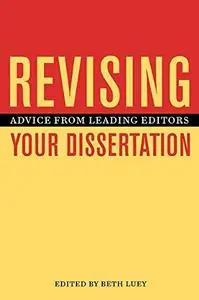
Revising Your Dissertation: Advice from Leading Editors By Beth Luey (ed.)


Revising Your Dissertation: Advice from Leading Editors

Revising Your Dissertation: Advice from Leading Editors By Beth Luey (ed.)
2004 | 262 Pages | ISBN: 0520242556 | PDF | 1 MB


The aftermath of graduate school can be particularly trying for those under pressure to publish their dissertations. Written with good cheer and jammed with information, this lively guide offers hard-to-find practical advice on successfully turning a dissertation into a book or journal articles that will appeal to publishers and readers. It will help prospective authors master writing and revision skills, better understand the publishing process, and increase their chances of getting their work into print. In this guide experienced editors of scholarly books tackle such subjects as addressing a target audience, broadening a topic, reorganizing, developing a voice, and finding the best documentation system. Specific chapters address authors in different academic fields: the humanities, social sciences, sciences, and arts. The guide also gives advice to authors of books on topics of regional interest and of books written for practicing professionals. Revising Your Dissertation will be useful for students who are developing a dissertation topic or are in the process of writing a dissertation, as well as those who have completed a dissertation they wish to bring to a wider audience

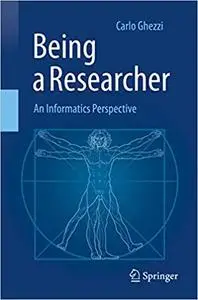
Being a Researcher: An Informatics Perspective


Being a Researcher: An Informatics Perspective

Carlo Ghezzi, "Being a Researcher: An Informatics Perspective"English | ISBN: 3030451569 | 2020 | 148 pages | 


This book explores research from the researchers’ perspective: why to engage in research, what methods to follow, how to operate in daily life, what the responsibilities are, how to engage with society, and the ethical issues confronting professionals in their day-to-day research.
The book systematically discusses what every student should be told when entering academic or industrial research so that they can avoid going through the painful process of learning by personal experience and lots of errors. Rather than being technical, it is philosophical and sometimes even anecdotal, combining factual information and commonly accepted knowledge on research and its methods, while at the same time clearly distinguishing between objective and factual concepts and data, and subjective considerations.
The book is about scientific research in general and as such holds true for any scientific field. However, it is fair to say that the different fields differ in their research cultures and in their eco-systems. The book reflects the author’s experience accumulated over almost 50 years of teaching graduate courses and lecturing in doctoral symposia at Politecnico di Milano, University of Zurich, TU Wien, Peking University, and at various conferences, and of academic research in informatics (also known as computer science).
This book is mainly intended for students who are considering research as a possible career option; for in-progress researchers who have entered doctoral programs; and for junior postdoctoral researchers. It will also appeal to senior researchers involved in mentoring students and junior researchers.


Build chatbots for Android using Dialogflow,Android studio


Build chatbots for Android using Dialogflow,Android studio

Build chatbots for Android using Dialogflow,Android studio
Video: .mp4 (1280x720, 30 fps(r)) | Audio: aac, 44100 Hz, 2ch | Size: 1.14 GB
Genre: eLearning Video | Duration: 27 lectures (2 hour) | Language: English

Develop your own Android Assistant and chatbots for Android using Dialogflow and NLP.Intelligent Android App Development.

What you'll learn

How to develop their own Android virtual Assistant
Build chatbots for Android using Dialogflow and Android Studio
Build responsive Applications for Android
Practical use of NLP(Natural Language Processing) in Android
Build chatbot to answer common questions
Chatbots to Launch Application and Games on Android
Chatbot for doing web search on Android
Build chatbots for making calls and sending SMS
Build chatbot for opening Maps and Starting navigation on Android
Use of API AI in Android App Development
Explore Features of Dialogflow
Integrate existing chatbot inside your own chatbot
Integrate Dialogueflow chatbots in Android using Android Studio
Combine different chatbots to build Assistant for Android

Requirements

Basic Knowledge of Android Development

Description

Requirements

You should have some basic knowledge of Android App Development using Java

Description

If you have basic knowledge of Android Development and want to build chatbots and smart Android Apps for Android you are at the right place.

Welcome to the most comprehensive course for developing chatbots and building a Virtual Assistant for Android. Learn concepts, tools, and techniques that you will need to build fully functional chatbots for Android Devices.

After completing this course you will be able to build chatbots for Android and add chatbots inside existing Android Applications. Apart from that, you will have your very own Assistant.

Curriculum:

In this course, we will build our very own Assistant and chatbots for Android using Dialogflow and Android Studio. We will start by looking at Dialogflow API and the features it provides. Then we will build our first chatbot for Android using Dialogflow and Android studio. After that, we will learn about the different components of Dialogflow and build different chatbots. Our Assistant will be a combination of these small different chatbots.

We will firstly name our Assistant than we will build different chatbots and add them inside our Assistant. We will build chatbots for

Telling Jokes

Doing Websearch for us

Launching Application and Games

Sending SMS

Making Calls

Translating text

Answering common questions

Opening Maps and starting Navigations

and much more

For each feature of our Assistant, we will build a chatbot and add it inside our Assistant. For each chatbot we will firstly train our Dialogflow agent then we will write the code to implement that feature in Android using Android studio.


This course features an ever-evolving project-based curriculum that will see new sections, case studies, and examples being added on a regular basis. This is critical because this technology space is growing by leaps & bounds and consequently this course aims to keep up with the pace. All of this comes with personalized help, hand-holding, and support.

And even before reaching the end of the course, you will be able to build your very own Personal Assistant for Android which contains features of different chatbots. We will also explore prebuilt chatbots and customize them and add them inside our Android Assistant.

Almost all industries, ranging from entertainment, medicine, hospitality, performing arts, banking, aviation, and more are already eyeing the chatbot space to enhance customer engagement for business and marketing.

The bottom line is - we're at a stage in the evolution of chatbots where mobile apps were back in 2007 when Apple announced the first iPhone.

Grab the opportunity today.

Join me, as we understand, design, and build our own Android Assistant and chatbots.

Who this course is for:

Beginner Android Developers want to develop smart Android Applications using Java and Android Studio
Beginner Android developer want to build chatbots for Android using using Android studio
Programmer want to develop their own Android virtual Assistant
Developers interested in practical implementation of Natural Language Processing
Programmers want to develop chatbots for Android